Connect. Create. Advocate.

The Library

The Library supports children, youth, families, and caregivers living with neurodevelopmental conditions. It strives to be a force for positive change in communities across BC.
The Library centres the voices of individuals with lived experience and their stories.

The Library turns to those with lived experience, letting them direct what goes into the Library.

The Library offers critical insights to researchers and policymakers about lived experience.

Interested in sharing your lived experience?

The Library welcomes anyone interested in learning more about neurodevelopmental condition(s). It is a space for individuals with lived experience and professionals investigating health and community issues to share and learn from these experiences.

Exploring individuals’ and family’s experiences with health and community services can help improve policy and programming that drive success factors for neurodiverse individuals. The Library of Lived Experience is a place of learning; one where academic journal articles and lived experience complement each other. We don’t want this to simply be a collection of academic and medical resources – this is where you come in!

If you feel comfortable sharing your lived experience and would like to submit a written, audio, or visual element to the Library, please complete the survey below. Once reviewed, your submission will be displayed in the Library on Tapestry.

Explore the Library

Using an open-source tool called Tapestry, the Library aims to show the value of lived experience. 

Using the Tapestry Tool allows the Library to be a collaborative, visual learning space.
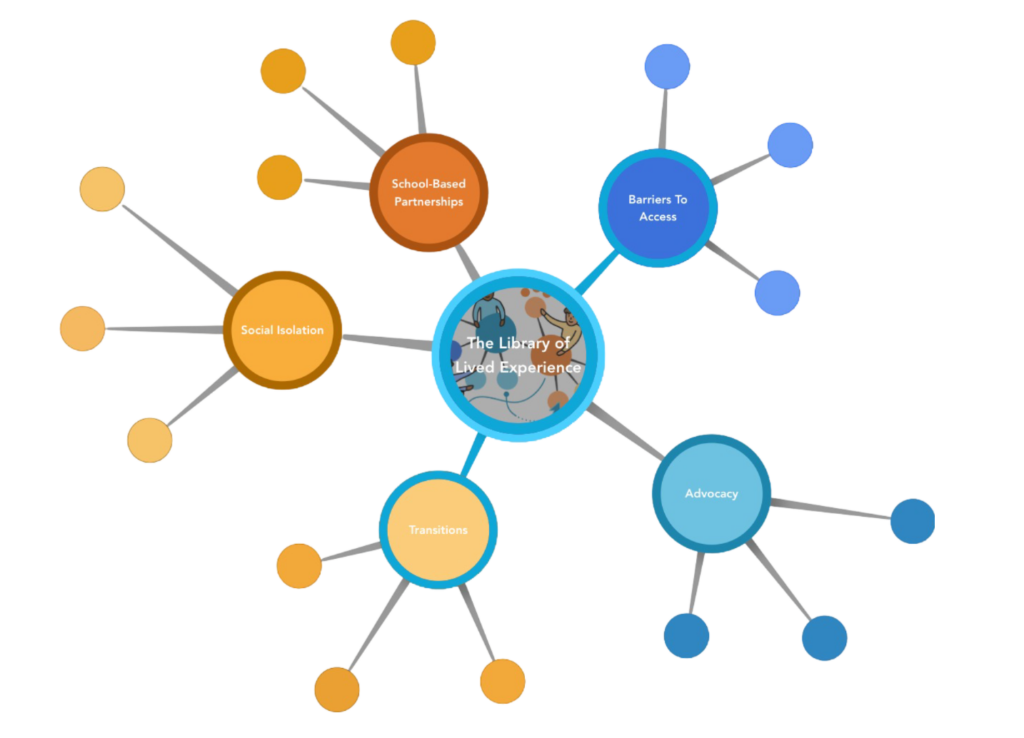
Each node represents a theme that is explored in greater detail.

Sub-nodes contain resources including academic articles, medical knowledge, and testimonies of lived experience. 

If you are interested in learning more about what the Library has to offer, click the button below.

Why turn to Lived Experience?

Miles Sibley, an advocate for patient experience in healthcare in the United Kingdom, noted that
“if you can’t find the evidence, you can’t act on it”.

While there is the expression of the individual voice, it is limited and there is no coherent collection of the lived experience to inform others, the clinical setting, or policy here in British Columbia. Miles’ comment was the very inspiration behind the Library of Lived Experience. Below you can listen to the Matters of Engagement podcast and learn more about Miles’ efforts in shifting the perspective on lived experience as evidence. This podcast is a powerful introduction to why the Library of Lived Experience is directed and developed by individuals with lived experience.